

Fresh travel and tourism news from the United Kingdom
Provided by AGP
AI-Powered Vending Redefines European Transit Retail: A New Era of Station Monetization
Across Europe's busiest railway stations and metro interchanges, a structural shift is underway in how operators extract value from the millions of commuters and travelers passing through their concourses each week. Traditional concession leases — once dominated by newsstands, bakery chains, and quick-service kiosks — are being supplemented, and in some cases replaced, by a new generation of automated retail units engineered to operate around the clock with minimal staffing overhead. Industry data from the European Vending and Coffee Service Association (EVA) indicates that unattended retail across European transit environments grew by more than 14% in 2023, outpacing nearly every other category of station-based commerce.
The driver is not novelty. It is economics. Labor costs across the UK, Germany, and France have climbed sharply since 2021, while passenger flows in major hubs have rebounded past pre-pandemic baselines. Station operators are under simultaneous pressure to monetize every square meter of dwell space and to keep service availability consistent during off-peak and overnight windows when staffed outlets historically went dark. The result is a procurement environment increasingly favorable to intelligent, self-operating retail formats that can deliver hot beverages, frozen desserts, fresh meals, and snacks without the fixed cost of a human shift.
Why Smart Vending Has Outgrown Its Old Definition
For decades, "vending" implied a limited proposition: a glass-fronted cabinet dispensing pre-packaged goods through a coil mechanism. That definition no longer describes what is being deployed in places like London King's Cross, Frankfurt Hauptbahnhof, or Milano Centrale. The current wave of smart vending machines integrates robotic actuation, computer vision, IoT-based inventory telemetry, contactless payment ecosystems, and remote diagnostics. Many units now prepare food on demand rather than dispense it pre-made — a distinction with significant implications for unit economics, food waste, and consumer perception.
An ai vending machine of the current generation is, in functional terms, closer to an unmanned micro-restaurant than to a snack dispenser. It assembles, customizes, and serves. It records every transaction with timestamp and SKU-level granularity. It pushes maintenance alerts before failures occur. And critically for transit operators, it occupies a footprint roughly equivalent to two standard luggage lockers — a fraction of what a staffed kiosk requires.
A Birmingham Case Study in Robotic Dessert Retail
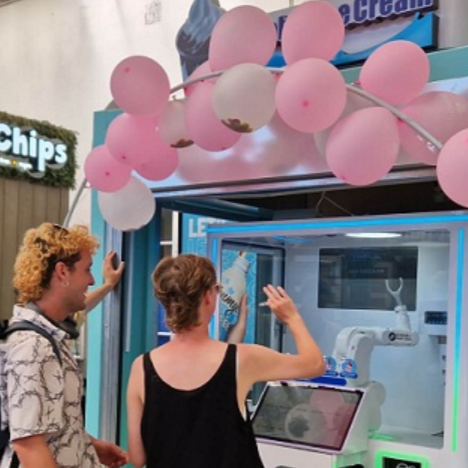
A concrete illustration of this trend arrived recently at Birmingham New Street, one of the United Kingdom's most heavily trafficked rail interchanges. An automated sundae ice cream kiosk developed by Anno Robot — a Chinese manufacturer specializing in robotic food and beverage systems — entered service at the station, marking the brand's first deployment inside a UK transit hub. The unit is not a vending machine in the legacy sense. It is a fully enclosed robotic station in which a mechanical arm executes the entire sundae-assembly sequence: portioning the soft-serve base, applying sauces, and finishing with toppings.
Operationally, the system delivers a finished, customized dessert in under 30 seconds. Travelers interact through a touchscreen interface that offers six sauce options — including chocolate and strawberry — alongside nut toppings, generating up to 20 distinct sundae combinations. The kiosk maintains precise temperature control for product integrity, uses EU-compliant food-contact materials, and incorporates automated sanitation cycles between orders. The preparation process is visible to the customer through a transparent enclosure, addressing a recurring concern in unattended food retail: trust.
Station management has framed the installation in capacity terms. During peak commuter windows, staffed F&B outlets routinely develop queues that spill into circulation corridors. A robotic unit absorbs a portion of that impulse demand without contributing to congestion or requiring additional staff scheduling. During off-peak and late-evening hours, when traditional concessions are closed or understaffed, the kiosk continues generating revenue per square meter — a metric station landlords increasingly use to benchmark tenant performance.
What Transit Operators Are Actually Buying
It would be a mistake to read deployments like the Birmingham installation as simple product placements. Station operators are not buying ice cream. They are buying a combination of operational characteristics that the older retail format could not provide. Understanding this distinction matters for any vendor, integrator, or property owner evaluating where automated retail fits into a portfolio.
Key Takeaways for Industry Practitioners
Dwell-time monetization is the real KPI. Transit hubs measure success by revenue extracted per passenger-minute of dwell. Automated units lift this figure precisely because they reduce the friction between impulse and purchase.
Labor arbitrage is no longer the headline benefit. The more compelling argument is service continuity — 24/7 availability that staffed outlets structurally cannot match without unsustainable scheduling costs.
Customization, not throughput, drives consumer acceptance. Early vending failed because it offered uniformity. The current generation succeeds by offering combinatorial variety within a controlled SKU set.
Hygiene transparency is a regulatory and reputational asset. Visible preparation and automated sanitation cycles answer questions that EU food authorities and consumers ask in the same breath.
Data exhaust is undervalued in current contracts. Every robotic transaction generates structured behavioral data that station operators are only beginning to price into lease agreements.
The Coffee Robot Precedent and What It Predicts
The deployment trajectory of robotic dessert kiosks closely follows the path already cleared by the coffee robot category, which moved from novelty installations in Asian shopping malls in 2018–2019 to mainstream fixtures in European airports, office lobbies, and university campuses by 2023. The coffee category demonstrated that consumers will accept — and often prefer — machine-prepared beverages when quality is consistent, customization is meaningful, and wait times are predictably short. Dessert, snack, and light-meal categories are now traversing the same adoption curve, compressed by the lessons learned from coffee deployments.
What the coffee precedent also reveals is that the operators who win in this category are not necessarily those with the most advanced hardware. They are those with the most disciplined service networks: rapid parts replacement, remote firmware updates, ingredient logistics integrated with point-of-sale telemetry, and localized menu engineering. A robotic unit that breaks down in a station concourse and waits three days for service does more reputational damage than a staffed outlet that simply closes early. Vendors expanding into European transit are increasingly judged on backend reliability rather than front-end spectacle. Companies that publish detailed reliability metrics and service infrastructure — visible on platforms such as www.annorobots.com — are positioning themselves accordingly as the category professionalizes.
Localization as the Next Competitive Frontier
One detail from the Birmingham deployment deserves more attention than it has received: the operator's stated intention to adjust recipes and flavor profiles for local taste preferences before expanding to London and Manchester. This signals a maturation in how Asian robotics manufacturers are approaching European markets. Earlier waves of export-oriented automated retail often assumed that hardware sophistication would translate directly across geographies. It rarely did. British dessert preferences differ from German ones, which differ again from Italian and Spanish norms. The same is true of coffee strength, portion size, and sweetness tolerance.
The competitive frontier in European unattended retail is therefore shifting from "can the machine perform the task" to "can the operator tune the offering to the location." This favors vendors with flexible software-defined menus, modular ingredient bays, and the willingness to invest in local market research before mass deployment. It penalizes vendors who treat each new country as a copy-paste of the last.
What to Watch Over the Next 18 Months
For industry practitioners — whether you operate stations, manage F&B portfolios, develop automated retail hardware, or invest in the category — three indicators will reveal how durable this trend becomes. First, watch lease structures. When station landlords begin offering revenue-share rather than flat-rent terms specifically tailored to automated units, it confirms the category has been institutionalized. Second, watch insurance and certification frameworks. The EU is actively refining standards for unattended food preparation, and the vendors who shape those standards will shape the market. Third, watch the geography of deployment. The movement of robotic kiosks beyond flagship hubs into secondary stations, intercity coach terminals, and ferry ports will indicate whether the economics work at lower passenger volumes — the true test of category viability.
The Birmingham installation is a single data point. But it sits inside a pattern that is becoming difficult to dismiss as experimental. The question for transit operators across Europe is no longer whether automated retail belongs in their concourses. It is which categories to onboard first, which vendors to standardize on, and how to renegotiate concession contracts in a world where a robotic arm can generate fifty pounds of revenue per hour at three in the morning. Those who treat that question as urgent will define the next decade of station commerce. Those who treat it as optional will spend that decade catching up.
Anno Robot
RobotAnno(ShenZhen) Co., Ltd.
+86 16602860929
celine@annorobots.com
Visit us on social media:
LinkedIn
Facebook
YouTube
Legal Disclaimer:
EIN Presswire provides this news content "as is" without warranty of any kind. We do not accept any responsibility or liability for the accuracy, content, images, videos, licenses, completeness, legality, or reliability of the information contained in this article. If you have any complaints or copyright issues related to this article, kindly contact the author above.
